Human City
AAT | 2026
Premiere in 2026 March 12,13th 19:00 in Vilnius old theater
Duration 70 min | N-16
THE CITY AS A BODY: SUBCONSCIOUS ARCHITECTURE BETWEEN SOUND, MOVEMENT, AND MEMORY
In this interdisciplinary performance, the city becomes a living organism: its heart beats with electronic sound, its voice with choral vibrations, its skin with light and image. We are creating a high-rise dream where the highs are not high – they are states: anxiety, euphoria, memory, emptiness, burnout, longing. Urban nightmare. Urban paradise.
director, scenographer and author of the play: Artūras Areima
costume designer: Valdemara Jasulaitytė
video artist: Kristijonas Dirsė
music composer: Dominykas Digimas
stage operator: Martynas Ungurys
prop artist: Arina Lykova
social research consultant, anthropologist: Jekaterina Lavrinec
actors: Karolis Maiskis, Monika Poderytė
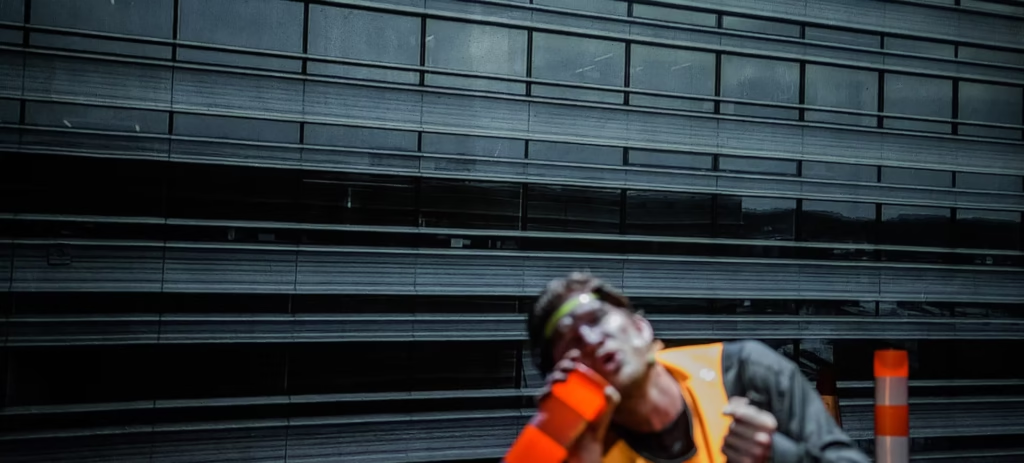
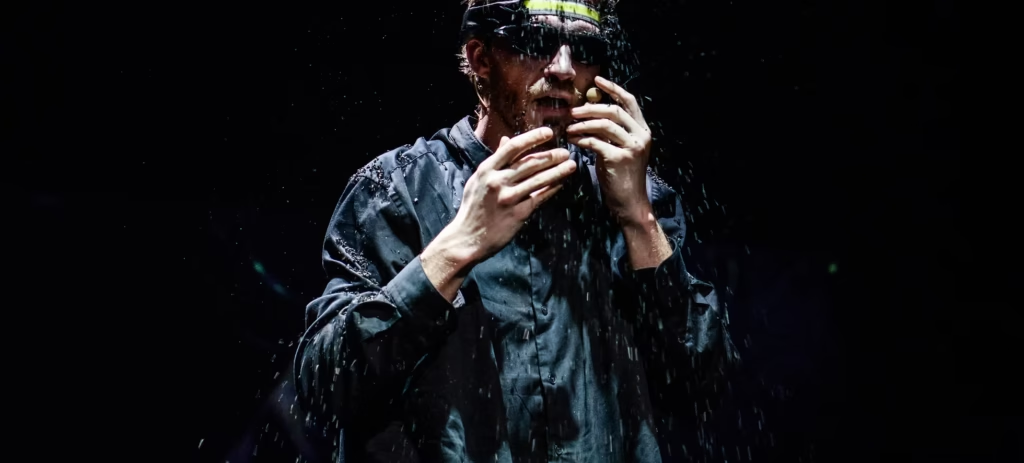
“The second stage setting consists of video projections by Kristijonas Dirsė, shown in the background throughout the entire performance. Watching them, I thought to myself that it had been a long time since I’d seen such beautiful imagery and such calm camerawork. If my eyes couldn’t find a place to rest within the action on stage, they could always find repose in the city unfolding across the projections—though this time, their aesthetics contrast with the actual content of the images.
The beautifully smoking chimneys of a thermal power plant, aesthetic piles of tires, and the glossy, world-reflecting facades of glass business centers are filmed so exquisitely that it is difficult to perceive the overt criticism directed at them within the play. Most of the images are devoid of people; objects and urban elements are left to exist on their own. Yet, this “man-less” world does not detract from their beauty or the internal elegance captured by the camera.”
The show’s composer, Dominykas Digimas, emphasizes his personal connection to Vilnius: “My relationship with Vilnius has been very close since the day I was born here. I observe and listen to it, no matter how boring it might seem. In that everyday routine, many colors emerge. The city is alive.”
According to the composer, the music is constructed like a city soundscape—from overlapping layers, constantly shifting noises, and rhythms: “There is never just one plane—these are layers overlapping one another. The music accompanies the actors; the actors become the music. The foreground is constantly shifting—it all depends on the observer’s attentiveness.” He compares the creative process to the city itself: “Each element can function independently, but by acting together, they create a new body.”
“Out of Artūras’s plays I’ve worked on, ‘Man – City’ is perhaps the least classical in form. Other works had specific characters whose dramas you experienced by identifying with them. Here, everything is much more poetic, the form is freer, there’s more playfulness and room for interpretation—the actors embody states rather than people, reflecting on their relationship with the city. I really liked that during the creative process, we had lectures, live meetings, and discussions with anthropologist Jekaterina Lavrinec. Since my undergraduate studies, I’ve been interested in psychogeography and participated in several experiments based on urban observation. It’s great that the playful and radical ideas of the Situationists are still alive today, and Jekaterina helped us understand and apply them to the play—the lectures and walks through the neighborhoods were a wonderful part of the creative process,” says video artist Kristijonas Dirsė.
“Man – City” is a performance about loneliness in a crowd, a body trapped between walls, a city that forgot why it was built, and a person who forgot where they live. It is an invitation to step inside the city, listen to its “internal organs,” and ask oneself: Am I still living in the city, or is the city already living in me?
Full article in Lithuanian here: https://www.7md.lt/teatras/2026-03-06/Zmogus-miestas–premjera-apie-miesta-kuris-pradeda-kalbeti